
Kerala Panel recommends Green Nod for ₹8,707-crore Thiruvananthapuram Airport Expansion
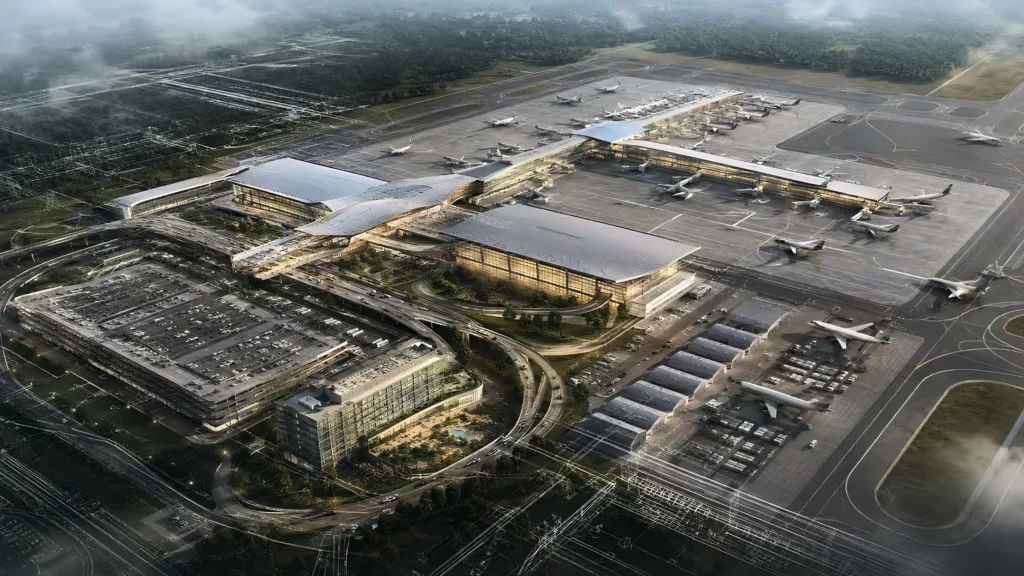
Expert panel clears path for Adani-operated airport’s ₹8,707-crore upgrade that will raise capacity to 27 million passengers; construction expected next financial year
Thiruvananthapuram: Kerala’s aviation infrastructure received a major boost after the State Expert Appraisal Committee (SEAC) recommended environmental clearance (EC) and Coastal Regulation Zone (CRZ) clearance for the proposed expansion of Terminal 2 at Thiruvananthapuram International Airport.
The ₹8,707-crore project aims to increase the airport’s passenger-handling capacity to 27 million passengers per annum (MPPA) and its cargo-handling capacity to 0.42 million tonnes per annum (MTPA). The project now needs the final approval of the State Environment Impact Assessment Authority (SEIAA). Airport sources expect the authority to grant the approval soon and describe it as “largely a formality.”
SEAC-1 made the recommendation during its 217th meeting, which it held on August 13 and 14. After SEIAA grants the final clearance, Thiruvananthapuram International Airport Ltd (TIAL) can move ahead with tenders and construction. TIAL, a subsidiary of the Adani Group, operates the airport under a 50-year concession agreement that it signed in January 2021. The company expects construction to begin in the next financial year.
Project Scale and Scope
The expansion will cover the airport’s existing 248.29 hectares of land. The project also needs another 6.88 hectares to meet Directorate General of Civil Aviation (DGCA) safety requirements and improve airside and landside operations.
The airport’s master plan proposes around 5.52 lakh square metres of total built-up area. The project will include the complete redevelopment of the international Terminal 2, a new cargo complex, upgrades to aprons and taxiways, new forecourts, commercial and utility areas, multi-level parking for 3,510 vehicles, office spaces, an airport hotel and modern air traffic control facilities.
The airport has already started airside development works worth around ₹600–650 crore. ULCCS has secured the contract for these works. Recent tender documents value the larger Terminal 2 package at around ₹2,700 crore. The airport plans to start work on this package in late 2027 and complete it by mid-2030.
The airport has included the entire expansion plan under “Project Ananta”, its long-term programme to modernise the airport.
The airport currently handles much less traffic than the proposed future capacity. It recorded its highest monthly passenger traffic of more than 4.5 lakh passengers in January 2026. In recent full years, the airport handled around 4.7–4.9 million passengers. During peak periods, traffic has reached or crossed the airport’s design limits.
The planned capacity of 27 MPPA will strengthen Thiruvananthapuram’s position as a major southern gateway. The airport will serve the state capital region, southern Kerala, parts of Tamil Nadu and the growing tourism and IT sectors connected with Technopark and Vizhinjam port.
The Green Nod and Tree Impact
The impact on trees remains an important public concern. The expansion will affect around 280 trees. SEAC has directed the authorities to give priority to transplanting timber-yielding tree species instead of cutting them down.
The airport must also maintain a two-hectare green area under its landscape plan. The final clearance will likely include compensatory measures and geo-tagging requirements, as authorities normally require for such projects.
The number of affected trees remains relatively low compared with several greenfield airport and highway projects in other parts of India, where authorities have dealt with thousands or even tens of thousands of trees.
Airport authorities have highlighted their plans to use scientific methods for tree transplantation. They also plan to reuse excavated material at the project site for level-raising and backfilling. This approach will reduce the need to transport material from outside and will help limit the project’s environmental impact.
Environmental Safeguards and CRZ Clearance
The Kerala Coastal Zone Management Authority had already issued its CRZ recommendation in December 2025.
The National Centre for Earth Science Studies conducted a coastal study and found that 19.05 hectares of the airport area falls under CRZ-II limits. SEAC’s integrated recommendation therefore covers both environmental clearance and CRZ clearance for a 10-year period.
The airport must continue to follow the conditions attached to existing clearances and also implement the additional safeguards that SEAC has recommended.
The major environmental conditions include:
- The airport must pass stormwater runoff through oil-water separators and silt traps before it discharges the water into the Parvathy Puthanar canal.
- The project must strictly control excavation and earth movement and should reuse excavated material mainly at the site.
- The airport must maintain the required green area.
- TIAL must follow its Environmental Management Plan (EMP).
TIAL has set aside ₹84.45 crore as capital expenditure under the EMP. It will also allocate ₹4.08 crore every year as recurring expenditure for environmental management.
Earlier, SEAC had rejected the original Corporate Environmental Responsibility (CER) proposal as inadequate and had asked TIAL to revise it. TIAL later revised the CER proposal further in line with SEIAA’s directions and uploaded it on the Parivesh portal.
The airport’s modernisation plan also includes several sustainability measures. TIAL plans to shift to 100 per cent green electricity by FY27 and increase solar power generation. The project will follow the Energy Conservation Building Code and include rainwater harvesting.
The airport also plans to build a new 6.2 MLD sewage treatment plant. The plant will allow the airport to recycle 100 per cent of the treated wastewater for horticulture, toilet flushing and HVAC systems.
The airport expects its demand for potable water to increase to 8.95 million litres per day.
Public Concerns and Local Context
A public hearing conducted by the Kerala State Pollution Control Board in August 2025 recorded several concerns from local residents and other stakeholders.
People raised concerns about land acquisition, possible pollution of the Parvathy Puthanar canal, tree cutting and employment opportunities for local residents.
Residents of areas such as Vallakadavu, Muttathara and Pettah have previously expressed concerns about land acquisition. They have referred to their experiences with compensation and relocation during earlier airport, VSSC and industrial projects.
Although the project needs only 6.88 hectares of additional land, some of this land belongs to private owners and the government. Related runway and safety works also involve areas near the fire station and BrahMos facilities.
Authorities will carry out separate social impact processes if the project requires land acquisition.
Airport sources and official documents say that the project will use the existing airport footprint as much as possible. They have also highlighted employment generation as one of the project’s major benefits.
The expansion will create direct jobs during construction and generate indirect employment through tourism, logistics and commercial activities.
Operator Background and Project History
Thiruvananthapuram International Airport began operations in 1932. It became Kerala’s first airport and remains the second-busiest airport in the state.
The Airports Authority of India awarded a 50-year concession for the airport, after which the Adani Group took over its management.
The airport received its original environmental clearance in 2005 when the Airports Authority of India managed it. Passenger traffic has continued to increase over the years, creating the need to expand the airport’s capacity.
The airport’s wider modernisation programme also includes city-side developments. These include a luxury hotel component that received a separate environmental clearance earlier. That project involved the transplantation of around 40 trees.
TIAL has already floated tenders for the main Terminal 2 works in phases. The airport authorities have planned the construction in stages so that the work does not disrupt existing airport operations.
Next Steps and Broader Significance
SEAC’s recommendation now moves the project to SEIAA for the final environmental clearance.
Airport sources expect authorities to float tenders and start construction of the Terminal 2 and hotel components in the next financial year. The airport expects the expanded facilities to become fully operational around 2030.
The expansion will turn Thiruvananthapuram International Airport into a future-ready hub that can handle continued growth in passenger and cargo traffic.
The project reflects a common challenge in India’s infrastructure development. Authorities need to expand aviation infrastructure to support tourism, business and regional connectivity, while also addressing environmental and local concerns.
In this case, the expert appraisal process appears to have accepted the project after considering its relatively limited additional land requirement and tree impact, along with its detailed Environmental Management Plan, CRZ compliance measures and focus on tree transplantation.
For residents of Thiruvananthapuram and passengers using the airport as a gateway to southern India, the expansion could bring shorter queues, better airport facilities, more flight options and stronger economic activity.
Environmental observers, however, will closely monitor how authorities implement the tree transplantation plan, protect the Parvathy Puthanar canal, maintain the promised green areas and shift the airport towards renewable energy.
The airport now awaits the final SEIAA clearance. Once it receives the approval, the ₹8,707-crore expansion plan will move closer to construction.
The project ranks among the largest infrastructure investments currently moving forward at the state capital’s airport. It has gone through years of procedural and environmental scrutiny and now stands ready to move from plans on paper to work on the ground.